
Comparison
Truck-Mounted Forklift vs. Towable Forklift: A Lower-Cost Way to Deliver Pallets
A piggyback forklift rides on the delivery truck and eats its payload on every run. A towable forklift hitches to a pickup you already own. Here is where each one wins.
Updated September 18, 2026 · 9-minute read · By the Equipter team, Leola, PA
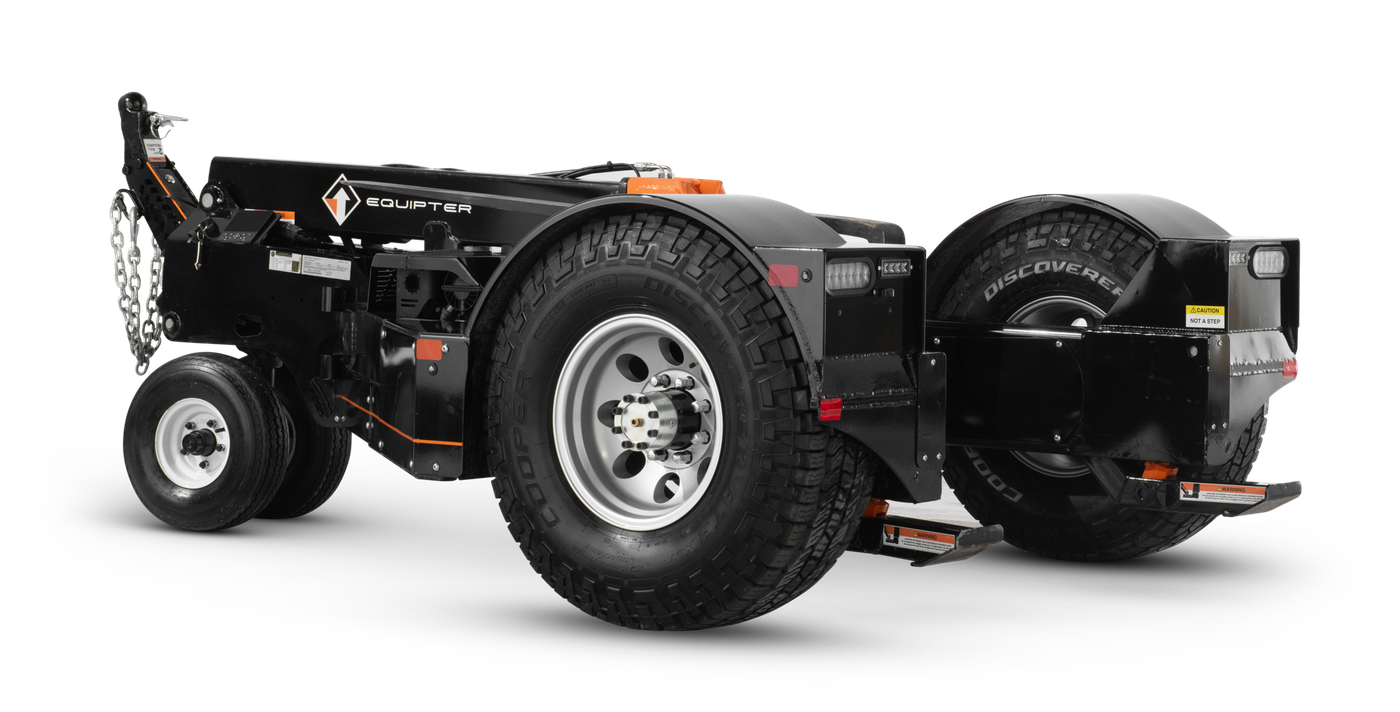
Equipter Tow-A-Lift specifications.
A truck-mounted forklift — a piggyback — is a compact rough-terrain forklift that clamps to the back of a flatbed and rides to the job with the load. Moffett (built by Hiab) and Princeton PiggyBack are the category leaders, joined by Donkey, Manitou and Loadmac. They typically lift 4,400–8,000 lb to 10–12 feet and mount or dismount in under a minute.
The trade is that the forklift travels everywhere the truck does. A Moffett M8 55.3 weighs 5,400 lb unladen; an M55 about 6,200 lb. That is payload you give up on every delivery, plus a flatbed fitted with a mounting kit and, usually, a CDL driver. The Equipter® Tow-A-Lift takes the other route: 3,160 lb, hitched behind any pickup in the yard.
The category
What a truck-mounted (piggyback) forklift is
Cecil Moffett invented the truck-mounted forklift in 1986, and the name stuck — plenty of yards call any piggyback "a Moffett" the way they call every copier a Xerox. The machine is a three-wheel, all-wheel-drive rough-terrain forklift with a mounting frame that locks onto a bracket at the rear of a flatbed truck or trailer.
It is a genuinely good design for what it does: the driver arrives, dismounts the forklift in under a minute, unloads the truck without a dock or a second person, remounts and drives to the next stop.
Who builds them
Moffett, built by Hiab in Ireland, is the market leader — the M4, M5, M8 and M9 ranges cover 4,400 to 8,000 lb. Princeton Delivery Systems builds the PiggyBack line, including the 5,500 lb PB55.3 and PB55.4. Donkey, Manitou and Loadmac round out the category.
Model numbers usually give the capacity away: an M55 or M8 55.3 lifts 5,500 lb.
What they lift
The working class of the category is 5,000–5,500 lb to a 10 or 12 foot mast, with four-way steering and pantograph reach available for single-side offloading.
Machine weight runs 5,400 lb for an M8 55.3, about 6,200 lb for an M55 and roughly 7,200 lb for an M55.4.
Where they shine
High-drop days. If a truck makes eight or ten stops and every one needs a 5,000 lb pallet placed on a commercial site, a piggyback is hard to beat.
One driver covers the whole route without a dock, a helper or a rental.
The real number
What a truck-mounted forklift actually costs
The machine is the part people price. It is rarely the biggest part.
What you buy
- The forklift. Used Moffett M8 55.3 units commonly list between about $18,900 and $54,900 depending on year and hours; across the range, used piggybacks broadly run $21,250 to $51,000.
- The flatbed. It needs a mounting kit fitted to the rear, and the mounted machine has to satisfy state rear-overhang rules, commonly 48 to 60 inches.
- The driver. A single vehicle with a GVWR of 26,001 lb or more requires a CDL, and most flatbeds built to carry a piggyback are in that class.
- The training. The forklift is a powered industrial truck, so OSHA 29 CFR 1910.178(l) certification applies to whoever runs it.
The payload you give up
- The forklift rides on the truck on every run, loaded or empty.
- At 5,400–7,200 lb depending on model, that is roughly three tons of your legal payload committed before a single pallet goes on.
- On a route where only two stops out of ten actually need a forklift, you hauled it to the other eight anyway.
- It also occupies the rear of the deck, which shapes how the load is stacked and strapped.
None of that makes a piggyback the wrong tool. It makes it a route tool — it earns its keep when most stops need lifting. The moment a yard is buying one so that a few deliveries a week can get past the curb, the economics stop working, and that is the gap a towable forklift fills.
The alternative
A forklift that follows the truck instead of riding on it
A towable outdoor forklift is the same idea turned around. Instead of the delivery truck carrying its own forklift, the forklift tows behind whatever vehicle is going that way — and only on the days it is needed.
The truck keeps its deck
Nothing is mounted to the flatbed, so the full rated payload stays available for product on every run.
At 3,160 lb the Tow-A-Lift is towed, not carried.
A pickup already in the yard
It hitches like a trailer. A Class A CDL is triggered only when the combination is rated 26,001 lb or more and the towed unit's GVWR tops 10,000 lb — neither applies here.
Check your vehicle's tow rating and hitch before hauling.
It crosses the property
Oversized flotation tires and a machine that weighs about what it lifts, so the pallet can land where the customer wants it rather than at the kerb line.
One person runs it on foot from a handheld remote.
Side by side
Piggyback and towable, compared
Read the payload row first if you are a supply house, and the placement row if your customers are residential.
Scroll the table sideways to see every column.
| Truck-mounted (piggyback) | Towable outdoor forklift | |
|---|---|---|
| Lift capacity | 4,400–8,000 lb; 5,000–5,500 lb is the common class | 3,000 lb (Tow-A-Lift) |
| Lift height | Typically 10–12 ft | 8'-0" (Tow-A-Lift) |
| Machine weight | About 5,400 lb (M8 55.3) to 7,200 lb (M55.4) | 3,160 lb empty (Tow-A-Lift) |
| How it travels | Mounted on the rear of the flatbed, on every run | Hitched behind any vehicle rated to tow it |
| Effect on payload | Its weight comes off the truck's legal payload | None — it is towed, not carried |
| Vehicle required | A flatbed with a mounting kit, usually CDL class | A pickup already in the fleet |
| Where the pallet lands | Past the curb, on firm ground near the truck | Across turf and gravel, at the work area |
| Typical cost | Used machines broadly $21,250–$51,000, plus the truck | Quoted through Build + Buy, with financing available |
Category figures are typical published specifications and used-market listing ranges; they vary by model, year, hours and region. Equipter figures are for current-production units. For the wider outdoor category, see the all-terrain forklift guide.
Fit
Which yards this suits
The towable case is strongest where deliveries are residential, intermittent, or spread across more trucks than you want to fit with mounting kits.
Roofing and building material suppliers
Shingle pallets land on the driveway today. A towable unit lets a crew truck take them to the staging point instead.
Lumber yards
Useful as a second machine when the piggyback truck is already out on a route and a short local drop still needs lifting.
Stone and landscape yards
Pavers, wall block and bagged goods go to the back of the property rather than the front of it.
Nurseries and growers
Trees, shrub racks and soil pallets move across soft ground without cutting ruts into a customer's lawn.
Pool and spa dealers
Chemicals, filters and equipment pallets get placed in a back yard through a side gate.
Fleets with many trucks
One towable unit can serve several trucks, where a piggyback belongs to the one flatbed it is mounted on.
The last stretch
Curbside delivery and the lawn problem
Every supply house knows the call: the pallet is on the driveway, the crew wanted it round the back, and nobody wants to be the one who drove three tons of machine across a finished lawn to get it there.
That is a weight problem more than a tire problem. A piggyback at 5,400–7,200 lb, or a rough-terrain forklift at 14,800 lb, is a lot of machine to put on turf. A 3,160 lb towable unit on oversized flotation tires is a different proposition — and the difference shows up in damage claims, not just in goodwill.
Where we fit
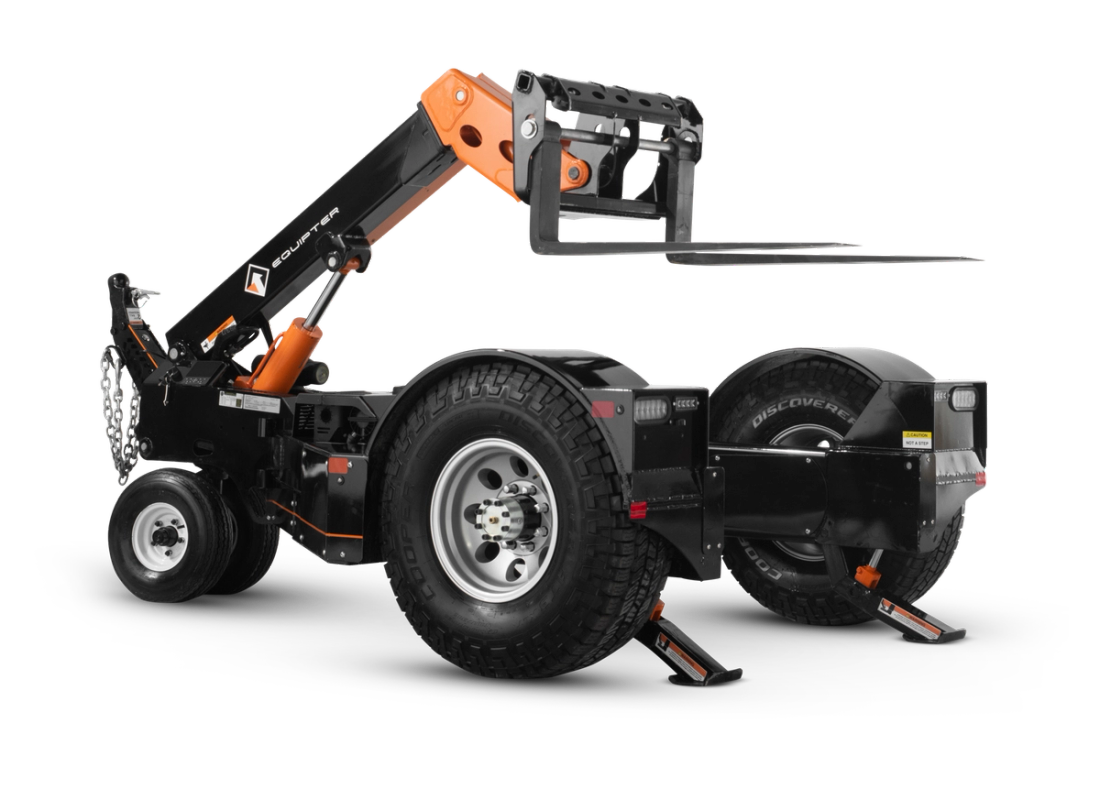
The Equipter Tow-A-Lift
It is not a piggyback and does not replace one on a ten-drop route. It is the machine for the deliveries that have to leave the driveway.
Specifications
- Lift capacity: 3,000 lb
- Lift height: 8'-0"
- Empty weight: 3,160 lb
- Drive: self-propelled, with a skid-steer driving mode for tight turns
- Transport: hitches to a standard pickup like a trailer; switches between Tow Mode and Work Mode in minutes
Controls and safety
- Handheld remote with joystick control and one-click pairing, operator on foot
- Emergency stop
- Outriggers for stability under load
- Work lights for low-light jobs
- Auto engage and disengage between tow and work modes
More on the controls in how the remote control forklift works. Check your vehicle’s tow rating and hitch before hauling any equipment.
Answers
Frequently asked questions
What is a piggyback forklift?
A piggyback forklift is a compact rough-terrain forklift that mounts to the back of a flatbed truck or trailer and travels with the load, so the driver can unload without a dock or a second person. Moffett and Princeton PiggyBack are the best-known makes. Capacities generally run 4,400 to 8,000 lb with a 10 or 12 foot mast, and the machine mounts or dismounts in about a minute.
Can you tow a forklift instead of mounting it?
Yes, and that is the whole idea behind a towable outdoor forklift. Rather than clamping to a flatbed, the machine tows on its own wheels behind a pickup, unhitches, and drives onto the site under its own power. You give up capacity — 3,000 lb rather than 5,500 lb — and gain the truck's full payload back plus the ability to cross ground a delivery truck cannot.
How much does a truck-mounted forklift cost?
Used piggybacks broadly list from about $21,250 to $51,000, with Moffett M8 55.3 machines commonly between $18,900 and $54,900 depending on year and hours. That is the machine only. Budget separately for a flatbed with a mounting kit fitted, compliance with state rear-overhang limits, and a CDL-qualified driver if the truck is rated 26,001 lb GVWR or more.
Do you need a CDL to run a truck with a piggyback forklift?
For the truck, usually yes: any single vehicle with a GVWR of 26,001 lb or more requires a commercial driver's licence, and most flatbeds built to carry a piggyback are in that class. Towing a 3,160 lb machine behind a pickup is a different case — a Class A CDL applies only when the combination is rated 26,001 lb or more and the towed unit's GVWR exceeds 10,000 lb. State rules can add requirements either way.
Which is better for residential delivery?
The towable one, in most cases. A piggyback unloads at the curb quickly and moves on, which suits commercial routes. Residential customers usually want the pallet somewhere the truck cannot go, and that is a question of how much machine you are willing to put on a lawn.
Does a towable forklift replace a piggyback?
Not on a dense delivery route with heavy pallets — that is what a piggyback is for. It replaces the second trip, the rental, or the six-man unload on the jobs where material has to get past the driveway, and it does that without taking payload off the delivery truck.
Deliver past the driveway
Spec a Tow-A-Lift for the drops your flatbed cannot finish — or rent one first and put it on a real delivery.
Keep reading
The whole outdoor category, compared on transport and turf.
The fleet and rental economics.
Specs, configurations and Build + Buy.