
Buyer's guide
Small Forklifts for Outdoor Work: Compact, Mini and Towable Options
Search “small forklift” and you get warehouse machines. Here is what actually happens when you take one outside, and what small should mean when the pallet has to cross grass, gravel or a half-graded lot.
Updated September 18, 2026 · 8-minute read · By the Equipter team, Leola, PA
Equipter Tow-A-Lift specifications.
Most small forklifts are indoor machines. Walkie stackers and compact counterbalance trucks are built for smooth, level concrete, and their manufacturers say so plainly — not for gravel, ramps, wet ground or turf. Take one onto a jobsite and the tires, the ground clearance and the stability all work against you.
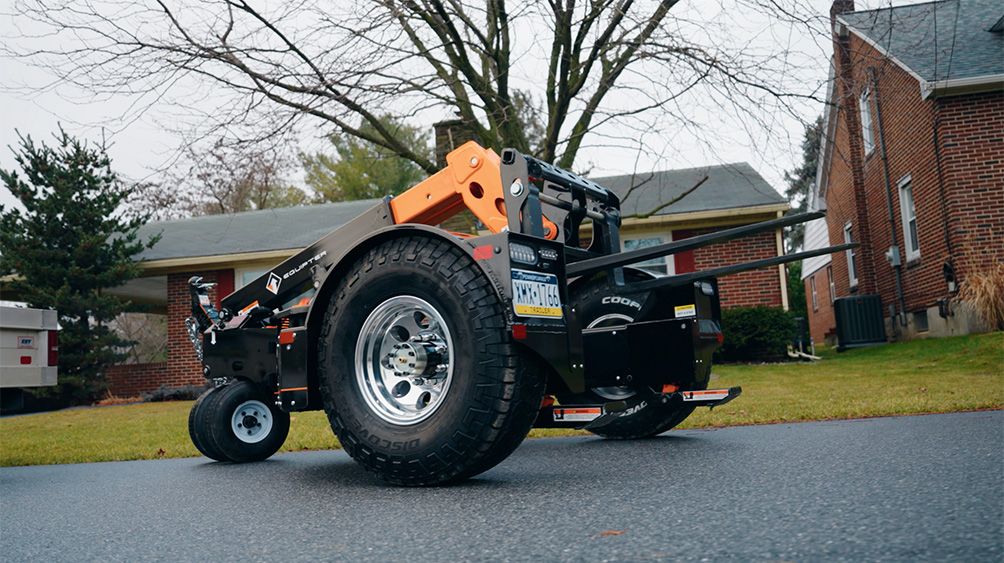
A small outdoor forklift is a different machine: high-flotation tires, real ground clearance, and stability that comes from outriggers or a wide stance rather than a low-slung counterweight. The Equipter® Tow-A-Lift is that type: 3,000 lb of capacity in a machine that weighs 3,160 lb and hitches to a pickup.
The category
Three kinds of small forklift — and where each one can actually work
“Small forklift”, “mini forklift” and “compact forklift” get used for three different machines. Two of them are warehouse equipment. Sort them by the surface they are rated for, not by the size of the price tag.
Walkie stackers
The machine most people find when they search for a mini forklift. The operator walks behind it, straddle legs go around the pallet, and an electric mast lifts. Capacities typically run 2,000–3,300 lb with lift heights from about 78 to 157 inches, and prices start under $2,000.
Manufacturers are explicit that these are for flat, dry indoor floors — not sloped driveways, ramps, gravel or rough ground.
Compact counterbalance forklifts
The classic sit-down forklift in a 3,000–5,000 lb class. On cushion tires it is a warehouse machine: small chassis, low ground clearance, tight turning radius. On pneumatic tires it can handle a paved yard, but the frame grows and so does the price.
Cushion-tire trucks sit low and lose traction off concrete. Even with traction tread, dirt and grass are not recommended surfaces.
Towable outdoor forklifts
Self-propelled, remote-controlled, and built for unimproved ground: oversized flotation tires, ground clearance, outriggers for stability under load. Small enough to hitch to a pickup, so it reaches the job without a trailer or a second driver.
The Equipter Tow-A-Lift lifts 3,000 lb to 8 feet and weighs 3,160 lb empty.
The problem
Why indoor mini forklifts fail outdoors
This is not a durability question. An indoor machine can be perfectly well built and still be the wrong tool the moment it leaves the slab, for four specific reasons.
Tires
Cushion tires are solid rubber pressed onto a steel band, designed for smooth concrete. Off it, traction drops and wear accelerates sharply. Small stacker wheels are worse: they are sized for a warehouse floor, not a lawn.
Ground clearance
Cushion-tire trucks have a smaller chassis and sit lower to the ground, so they hang up easily outdoors. A curb lip, a rut or a soft shoulder that a pickup would not notice will stop one.
Stability
A forklift's rated capacity assumes tires in good condition and appropriate for the surface. Uneven ground tilts the stability triangle, and cushion tires give almost no shock absorption, so the load and the mast take the hit.
Slope
Stacker makers warn specifically against sloped driveways and ramps, because incline operation creates tipping and braking risk. Most residential jobs start with a driveway that slopes.
The physics
Why a small forklift usually is not a light one
Here is the part that catches buyers out. A counterbalance forklift stays upright because of the weight bolted into its back end, so its service weight typically runs 1.5 to 2 times its lift capacity. Across a survey of more than a hundred models, a 3,000 lb-capacity forklift averaged about 6,500 lb, and a 5,000 lb-capacity one about 8,700 lb.
So “compact” buys you a smaller footprint, not a lighter machine. You still need a trailer and a truck rated to pull it, and you still put three tons on the customer's lawn to move fifteen hundred pounds of material.
Machine weight per pound lifted
- 3,000 lb counterbalance forklift — about 6,500 lb, roughly 2 lb of machine per pound of load
- 5,000 lb counterbalance forklift — about 8,700 lb, roughly 1.7 lb per pound of load
- Equipter Tow-A-Lift — 3,160 lb to lift 3,000 lb, close to 1 lb per pound of load
Where the difference comes from
A counterbalance truck carries its stability as dead weight at the rear, all of it riding on the machine at all times.
A towable outdoor forklift puts its stability on the ground instead: outriggers deploy where the lift happens, so the machine does not have to haul a counterweight between jobs.
That ratio is the whole argument for this category. It decides what tows the machine, what it does to turf, whether one person can run the job alone, and how often the thing actually leaves the yard.
Side by side
Small forklifts compared, outdoor first
Read the surface row first. Everything else is a detail if the machine cannot legally or safely be where your pallet needs to go.
Scroll the table sideways to see every column.
| Walkie stacker | Compact counterbalance | Towable outdoor forklift | |
|---|---|---|---|
| Rated surface | Flat, dry indoor floors only | Concrete; paved yards on pneumatic tires | Grass, gravel, dirt and graded lots |
| Lift capacity | 2,000–3,300 lb | 3,000–5,000 lb | 3,000 lb (Tow-A-Lift) |
| Lift height | About 78–157 in (6.5–13 ft) | Commonly 10–20 ft | 8'-0" (Tow-A-Lift) |
| Tires | Small load wheels, polyurethane | Cushion (indoor) or pneumatic | Oversized flotation tires |
| Machine weight | Light, but needs a truck or trailer to move it | About 6,500 lb at 3,000 lb capacity; about 8,700 lb at 5,000 lb | 3,160 lb empty (Tow-A-Lift) |
| How it gets to the job | Loaded into a box truck or trailer | Equipment trailer and a truck rated to pull it | Hitches to a standard pickup — no trailer |
| Operator position | Walking behind the machine | Seated on the machine | On foot, handheld remote |
| Where you buy it | Online and through dealers; entry models start under $2,000 | Dealer quote; new and used market | Quoted through Build + Buy, with financing available |
Category figures are typical published specifications across common models and vary by manufacturer and configuration. Equipter figures are for current-production units. If you need more than 3,000 lb or more than 8 feet of lift outdoors, the machines get much larger — see the all-terrain forklift guide.
Right-sizing
What “small” should mean outdoors
Indoors, small means narrow: a tight turning radius for a 10-foot aisle. Outdoors, aisle width is not the constraint. Three other things are, and they are what you should actually be shopping on.
Tow weight, not footprint
Can the truck already in your fleet move it? A machine you tow behind a crew pickup goes out on every job. One that needs a dedicated trailer and a rated tow vehicle goes out when someone has time to hook it up.
Weight on the ground
On finished lawns and soft shoulders, the machine's own weight matters more than the load. A 3,160 lb machine on oversized tires spreads its load very differently from a 6,500 lb truck on small ones.
One-person operation
If moving the machine takes a driver and running it takes an operator, every pallet costs you two people. A remote-controlled machine towed by the crew truck is a one-person job start to finish.
Where we fit
The Tow-A-Lift as the compact outdoor option
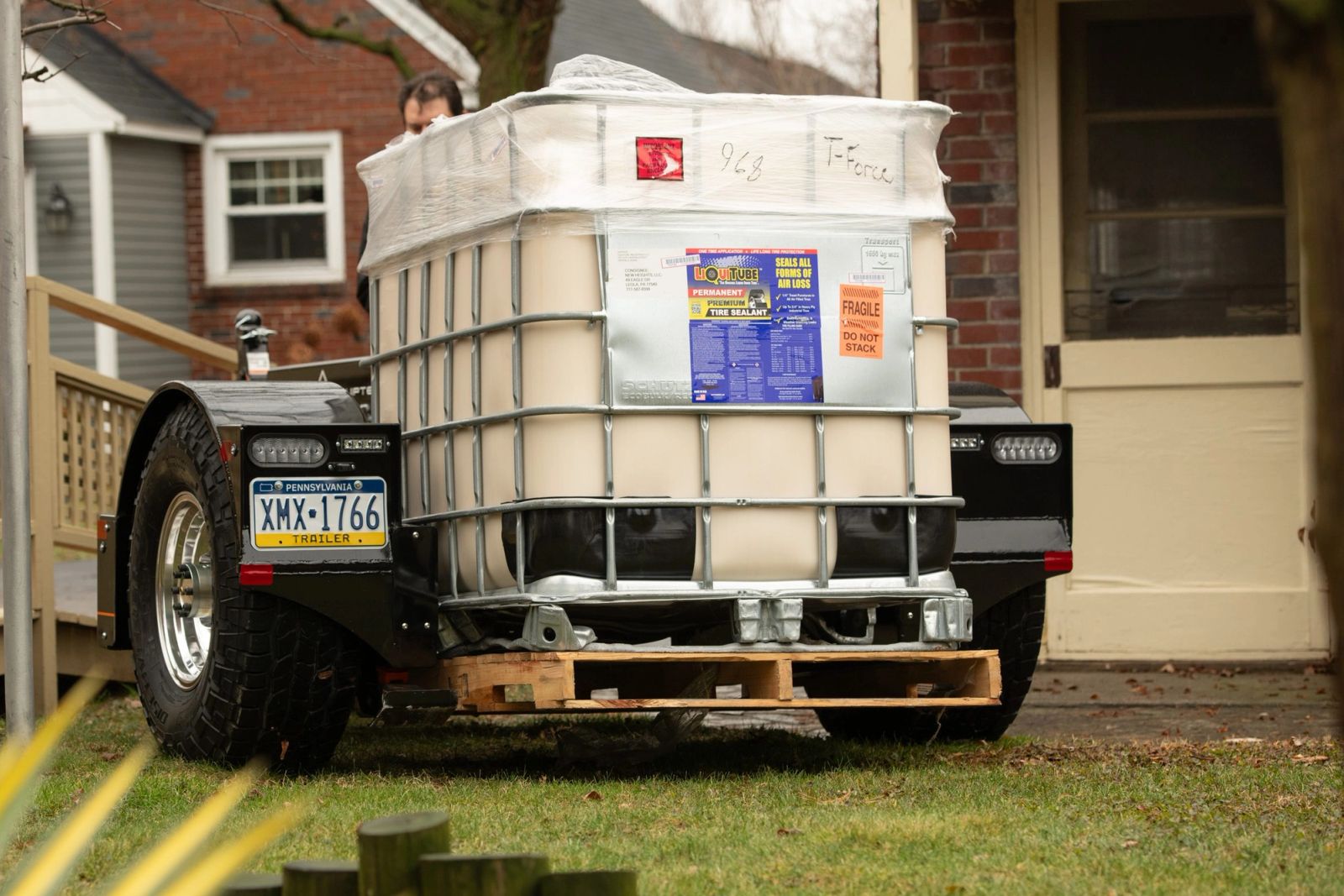
It is not the smallest forklift you can buy, and it is not trying to be. It is the smallest machine that will carry a full pallet across a finished lawn, fit between a house and a fence, and still be behind your pickup on the way to the next job.
Specifications
- Lift capacity: 3,000 lb
- Lift height: 8'-0"
- Empty weight: 3,160 lb
- Drive: self-propelled, with a skid-steer driving mode for tight turns
- Transport: hitches to a standard pickup like a trailer; switches between Tow Mode and Work Mode in minutes
Controls and safety
- Handheld remote with joystick control and one-click pairing, operator on foot
- Emergency stop
- Outriggers for stability under load, in place of a fixed counterweight
- Work lights for low-light jobs
- Auto engage and disengage between tow and work modes
Used by roofing, hardscape and landscape crews, supply houses making site deliveries, rental fleets, and grounds and orchard crews on soft ground. More on the controls in how the remote control forklift works. Check your vehicle’s tow rating and hitch before hauling any equipment.
Answers
Frequently asked questions
What is the smallest forklift you can buy?
The smallest powered option is a walkie stacker: the operator walks behind it, capacities run from about 2,000 to 3,300 lb, and entry models start under $2,000. They are genuinely small and genuinely cheap, but they are rated for flat, dry indoor floors. For outdoor work the smallest practical machine is a towable outdoor forklift, which trades a little size for tires and clearance that work on turf and gravel.
Can a small forklift go on grass?
Not an indoor one. Cushion-tire forklifts sit low, have little ground clearance and lose traction off concrete, and even with traction tread, dirt and grass are not recommended surfaces. Walkie stackers are rated for level indoor floors only. Crossing a lawn takes a machine designed for it: flotation tires, ground clearance, and stability that does not depend on a flat surface.
What is the difference between a mini forklift and a compact forklift?
In practice the terms are used loosely and often interchangeably. “Mini forklift” usually means a walk-behind stacker or a very small rider; “compact forklift” usually means a standard sit-down counterbalance truck in the 3,000–5,000 lb class with a tighter turning radius. Neither term tells you what surface the machine is rated for, which is the specification that actually matters outdoors.
Why is a small forklift so heavy?
Counterweight. A sit-down forklift balances its load with mass built into the rear of the machine, so service weight typically runs 1.5 to 2 times lift capacity — roughly 6,500 lb for a 3,000 lb-capacity truck. Machines that stabilize with outriggers instead can be far lighter: the Equipter Tow-A-Lift lifts 3,000 lb at 3,160 lb empty.
What can I use instead of a forklift on a jobsite?
Four realistic options. Have the supplier's boom truck place the material where you want it at delivery, if the truck can reach. Put forks on a skid steer you already own. Rent a rough-terrain machine for the day. Or use a towable outdoor forklift, which is the only one of the four that costs nothing extra to bring to every job once you own it.
Do you need certification to operate a small forklift?
Yes, and walkie stackers are included. Powered industrial trucks fall under OSHA 29 CFR 1910.178(l), which requires the employer to train, evaluate and certify each operator for the specific truck type and workplace, with re-evaluation at least every three years. There is no national OSHA licence; the employer's certification record is the legal document.
Small enough to tow. Built to go outside.
Spec a Tow-A-Lift for the pallets you move and the truck you already own — or rent one first and put it on your ground.
Keep reading
When you need more than 3,000 lb or more than 8 feet.
Where the operator stands, and why it matters on soft ground.
Specs, configurations and Build + Buy.