
For contractors
A Jobsite Forklift for Contractors: Move Pallets Across Lawns, Gravel and Tight Lots
The supplier drops at the curb. The work is two hundred feet away, across a finished lawn and through a gate. That last stretch is the job this machine exists for.
Updated September 18, 2026 · 8-minute read · By the Equipter team, Leola, PA
Equipter Tow-A-Lift specifications.
A jobsite forklift is one rated for the ground you actually work on — grass, gravel, mud and half-graded lots — rather than a warehouse floor. The category runs from 14,800 lb rough-terrain machines down to towable units a crew pickup can haul.
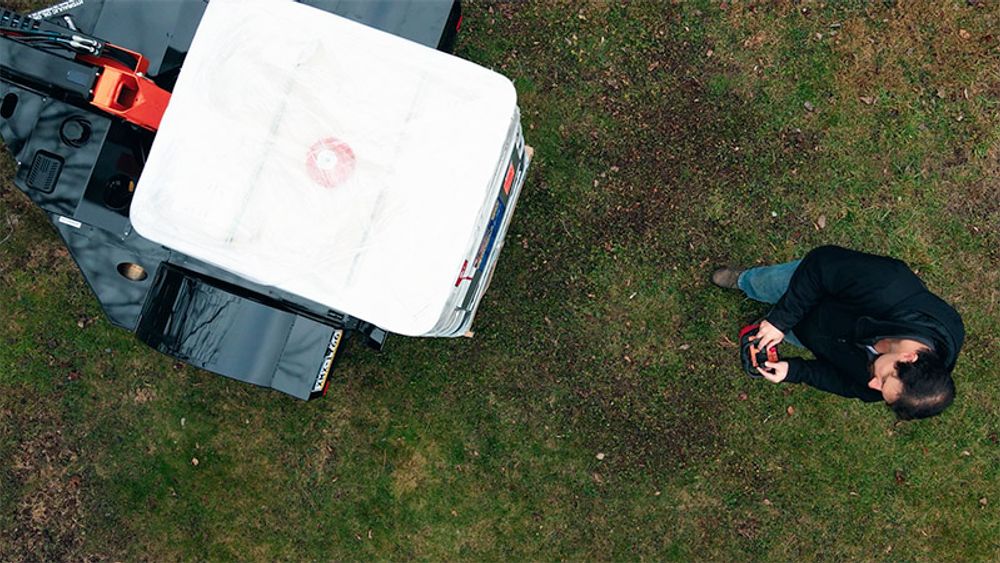
For most residential trades the constraint is not capacity. It is that the pallet has to cross the customer's property without wrecking it, and that the machine has to arrive without a flatbed and a second driver. The Equipter® Tow-A-Lift lifts 3,000 lb to 8 feet, weighs 3,160 lb, and hitches to the truck already on site.
The problem
The last two hundred feet
Material delivery ends where the delivery truck runs out of road. The driver is not going to take a loaded flatbed over a septic field, a paver driveway or a lawn that was seeded last spring, so the pallet comes off at the curb and the rest is yours.
From there most crews have three options, and all of them cost something: carry it by hand, rent a machine and pay delivery both ways, or drive something across the grass and hope. The fourth option is a machine small enough to tow with the truck already parked out front.
Move it by hand
Two or three people, an hour, on a pallet that weighs most of a ton and a half. It is the hidden labour line on residential jobs and it never appears on an estimate.
Rent a machine
$300–$600 a day plus $100–$300 of delivery each way, and it only arrives when the rental yard has a truck free.
Bring your own
A towable unit hitched to the crew truck that arrives when you do and leaves when you leave.
By trade
What each crew is actually lifting
The pallets differ; the two hundred feet does not. Weights below are typical and worth checking against your own supplier's packaging.
Shingles to the staging point
A pallet of architectural shingles — 42 bundles at 60–80 lb — runs 2,520 to 3,360 lb. Getting it from the driveway to the base of the ladder is the whole problem.
For tear-off debris on the same job, the Equipter 4000 is the machine that handles the other direction.
Pavers, block and wall stone
A standard paver pallet runs 2,500–3,500 lb, and 8x8x16 block about the same at roughly 90 units. Large-format and natural stone go heavier.
Back-yard patios are the classic case: the material is heavy, the route is narrow, and the finished lawn is the client's.
Sod, soil and mulch
A sod pallet is 1,500–3,000 lb and heavier after rain. A 60–70 bag mulch pallet is typically 1,300–2,800 lb depending on material and moisture.
Sod is also the most time-sensitive load on this list — it does not improve while it sits on the kerb.
Posts, panels and concrete
Fence work is spread along a property line rather than stacked in one place, so the machine matters less for the lift than for the distance.
Bagged concrete and post bundles are moved to where the line runs, not to where the truck stopped.
Equipment through a side gate
Filters, heaters, chemical pallets and coping stone all have to reach a back yard through an opening sized for people.
Machine width and a remote operator on foot matter more here than lift height.
Panels and condensers
Palletised panels, racking and outdoor units land on the driveway and need to reach the array or the pad.
Usually well within 3,000 lb, and usually across ground the delivery truck avoided.
Property damage
Keeping the lawn out of the punch list
Turf damage is mostly a weight problem, and the load is rarely the heavy part — the machine is. Compare what the category puts on the ground before it picks anything up:
What the machine itself weighs
- Masted rough-terrain forklift, 6,000 lb class — about 14,800 lb
- Compact telehandler — about 10,000 lb
- Truck-mounted piggyback forklift — 5,400–7,200 lb
- Equipter Tow-A-Lift — 3,160 lb
What actually helps
- Oversized flotation tires spread the load rather than concentrating it.
- Plan the route before the first pass — repeated turns in one place do most of the visible damage.
- Stay off saturated ground. No tire package makes a soaked lawn safe to cross.
- Working on foot with a remote gives a clear view of both the load and the ground you are putting it on.
Worth being straight about it: any machine can mark turf if the ground is wet enough or you turn in the same spot often enough. Less weight and wider tires reduce the risk; they do not remove it.
Utilisation
One machine across several trucks
A towable machine is not tied to a vehicle. Any truck in the fleet rated to tow it can take it, so it follows the work rather than sitting behind whichever truck it was mounted to.
That matters most for contractors running two or three crews: the machine goes to whichever job has pallets that day, and the crew that needs it does not have to wait for a specific driver to be free. Rent a second unit from the rental network on the weeks everything lands at once.
The machine
What you would be towing
Sized for the pallet that has to cross a lawn, not for the heaviest load on the site.
Specifications
- Lift capacity: 3,000 lb
- Lift height: 8'-0"
- Empty weight: 3,160 lb
- Drive: self-propelled, with a skid-steer driving mode for tight turns
- Transport: hitches to a standard pickup like a trailer; switches between Tow Mode and Work Mode in minutes
Controls and safety
- Handheld remote with joystick control and one-click pairing, operator on foot
- Emergency stop
- Outriggers for stability under load
- Work lights for low-light jobs
- Auto engage and disengage between tow and work modes
More on the controls in how the remote control forklift works. Check your vehicle’s tow rating and hitch before hauling any equipment.
Answers
Frequently asked questions
What is a construction forklift?
A construction forklift is one built for unimproved ground rather than a warehouse floor — larger high-flotation tires, more ground clearance and a frame that stays stable on uneven lots. OSHA classes rough-terrain machines as Class VII powered industrial trucks. The category covers masted rough-terrain forklifts, telehandlers and towable outdoor forklifts.
How do you move pallets on a job site without a forklift?
Four practical options. Ask the supplier's boom truck to place the material where you want it at delivery, if it can reach. Put forks on a skid steer you already own. Rent a rough-terrain machine for the day, budgeting delivery both ways. Or tow a compact outdoor forklift behind the crew truck, which is the only option that costs nothing extra to bring to every job once you own it.
Will a forklift damage grass?
It can, and the machine's own weight is usually the deciding factor rather than the pallet. A rough-terrain forklift around 14,800 lb or a compact telehandler near 10,000 lb puts far more into the turf than a 3,160 lb towable machine on oversized flotation tires. Saturated ground is the other half of it — on a wet lawn, no tire package makes heavy equipment safe to drive across.
What is the heaviest pallet a crew normally moves?
On residential work, usually something in the 2,500–3,500 lb band: architectural shingles at 2,520–3,360 lb, concrete block or pavers at 2,500–3,500 lb, sod at 1,500–3,000 lb. Wet sod and large-format stone can push past 3,000 lb, which is worth checking against a machine's rating before the truck arrives.
Do I need certification to run a forklift on a jobsite?
Yes. Under OSHA 29 CFR 1910.178(l) the employer must train, evaluate and certify each operator for the specific truck type and the conditions where it is used, with re-evaluation at least every three years. Construction sites add the requirements of 29 CFR 1926.602. There is no national OSHA licence — your certification record is the document.
Can one person run it?
Yes. It tows behind a pickup, drives itself off the hitch, and works from a handheld remote with the operator on foot, so moving it and running it do not need two people.
Finish the last two hundred feet
Spec a Tow-A-Lift for the pallets your crews carry by hand — or rent one and try it on the next job.
Keep reading
The whole outdoor category, compared on transport and turf.
Why a small forklift usually is not a light one.
Reach costs capacity, weight and money.