
Buyer's guide
Forklift vs. Telehandler: Which One Does a Small Crew Actually Need?
Telehandlers reach. Forklifts lift. Most small crews are buying one to solve a problem that is really about neither — getting a pallet from the curb to the work area without tearing up the property.
Updated September 18, 2026 · 9-minute read · By the Equipter team, Leola, PA
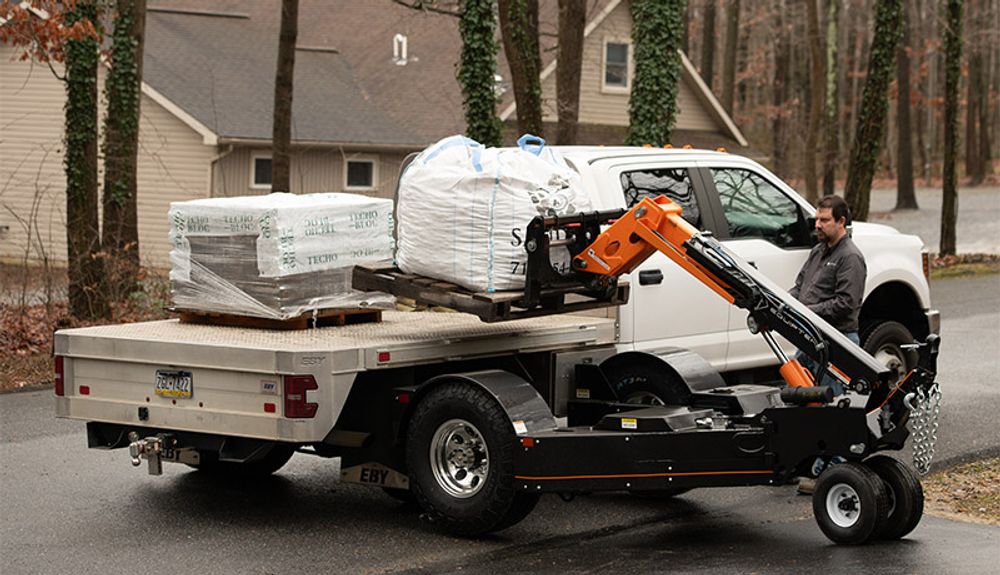
Equipter Tow-A-Lift specifications.
A telehandler is a forklift with a telescoping boom in place of a vertical mast, so it can extend a load forward and up — over a wall, onto a deck, across a trench. A standard forklift lifts straight up and sets the load close to the machine, so the machine has to get to the spot.
Reach costs capacity, weight and money: a compact telehandler rated 5,500 lb may carry only 2,600 lb at full height, weighs around 10,000 lb, and starts near $48,000 new. If the pallet is already on the ground and the problem is distance, not height, a towable outdoor forklift like the Equipter® Tow-A-Lift solves it for a fraction of the machine.
The core difference
Reach and lift are not the same purchase
Both machines are forklifts in the regulatory sense. The difference is what happens to the load once it leaves the ground, and it changes everything downstream — capacity, weight, transport and price.
The load goes out as well as up
A telescoping boom puts the load in places the machine cannot drive to: over a foundation wall, onto a second-floor deck, across a trench, up onto scaffolding. That is the capability you are paying for, and nothing else in this comparison does it.
The cost is a load chart. Capacity falls as the boom extends — sharply.
The load goes straight up, close in
A masted forklift keeps the load tight to the machine, which is why it holds its rated capacity through most of its lift. It has no reach at all, so the machine has to be able to get where the load is going.
Simpler, cheaper per pound lifted — and useless if a wall is in the way.
The compact class
Compact and mini telehandlers: what you get for the money
“Mini”, “small” and “compact” telehandler all describe roughly the same class: 2,700 to 5,500 lb of capacity, with the popular 5K machines lifting 5,000–5,500 lb to 18–20 feet. They are genuinely more manoeuvrable than a full-size telehandler. They are not small machines.
A real compact unit
- Rated 5,500 lb capacity
- 18 ft maximum height
- Only 2,600 lb at that maximum height
- Machine weight 9,990 lb
- 6 ft wide, 6 ft 4 in tall, 63 hp diesel
What it costs
- Compact 2.5–3.5 ton machines: roughly $48,000–$68,000 new
- Mainstream 6,000–10,000 lb models: roughly $78,000–$128,000 new
- Rental runs 10–25% above a straight-mast rough-terrain forklift
- Plus the trailer, the tow vehicle and delivery on every move
Read the load chart, not the headline number. The pattern holds right up the range: a 10,000 lb machine with 55 feet of forward reach carries about 2,000 lb out at that reach. The rated capacity is what the machine lifts with the boom retracted, right in front of itself — which is the one position where a much cheaper machine would have done the job.
The other side
When a forklift is the better buy
If the loads are going from a truck to the ground, or from the ground to a low roof edge or a first-floor opening, you are paying for a boom you will keep retracted. A masted machine gives you more capacity per dollar and per pound of machine.
Your loads stay low
Pallets off a delivery truck, material staged around a site, bulk bags and totes moved across a yard. None of it needs a boom.
You need full capacity, not reach
A masted machine holds its rating through most of the lift, so you buy for the pallet weight rather than for the pallet weight at 18 feet.
Reach is occasional
If it comes up a few times a year, renting a telehandler for those days is cheaper than owning one for all the others.
The third option
The problem most small crews are actually solving
Watch what happens on a residential job. The supplier drops the pallet at the curb because the truck will not cross the lawn. From there it has to travel two hundred feet, over turf, through a gate, to where the crew is working. Nothing about that is a reach problem. It is a transport problem, and both a telehandler and a rough-terrain forklift solve it by bringing five tons of machine to a job that needs three thousand pounds of lift.
A towable outdoor forklift is built for exactly that trip: it hitches to the crew pickup, drives itself off the hitch onto the site, crosses the grass on flotation tires, and sets the pallet down where the work is. One person, one truck, no trailer.
It arrives for free
At 3,160 lb it goes behind a pickup you already own, so there is no trailer, no rated tow vehicle and no second driver on the days it moves.
It crosses the property
Oversized flotation tires and a machine that weighs about what it lifts, rather than three times what it lifts.
It runs with one person
The operator works from a handheld remote on foot, which also means a clear view of the load instead of a view past it.
Side by side
Telehandler, forklift and towable compared
The row that decides it for most small crews is not capacity. It is how the machine gets to the job, and how many people that takes.
Scroll the table sideways to see every column.
| Compact telehandler | Masted rough-terrain forklift | Towable outdoor forklift | |
|---|---|---|---|
| Rated capacity | 2,700–5,500 lb | 5,000–12,000 lb | 3,000 lb (Tow-A-Lift) |
| Height | 18–20 ft on the 5K class | 11–29 ft | 8'-0" (Tow-A-Lift) |
| Reach past the machine | Yes — the reason to buy one | None — mast only | None — boom lifts, does not extend out |
| Capacity at full extension | About 2,600 lb on a 5,500 lb machine | Holds most of its rating; no extension | Check the load chart on every lift |
| Machine weight | About 10,000 lb | About 14,800 lb (6,000 lb / 21 ft unit) | 3,160 lb empty (Tow-A-Lift) |
| How it gets to the job | Equipment trailer and a truck rated to pull it | Flatbed or equipment trailer | Hitches to a standard pickup — no trailer |
| People to move and run it | Driver plus operator | Driver plus operator | One person, on foot with a remote |
| New price band | About $48,000–$68,000 for a 2.5–3.5 ton compact | Dealer quote; new and used market | Quoted through Build + Buy, with financing available |
Category figures are typical published specifications and market price ranges; they vary by manufacturer, configuration and region. Equipter figures are for current-production units. For the full outdoor category including larger machines, see the all-terrain forklift guide.
If reach is the requirement
When you really do need to reach, tow that too
If the load has to go up and over — setting trusses, feeding a second story, placing stone past a wall, lifting a unit onto a roof — a mast will not do it and you need a boom. You do not necessarily need a flatbed to bring one.
The mobile crane
- Max lift 4,431 lb
- Max reach 23 ft
- GVWR 7,500 lb — towable and drivable
The towable boom handler
- Lift capacity 4,000 lb
- Lift height 25'-5" with the container, 23'-5" with forks
- 11 ft boom extension · 6'9" wide · tare 9,880 lb
See the 7000 — currently available to order
Choosing between them is its own decision: the 5400 and 7000 compared.
Where we fit
Where the Equipter Tow-A-Lift fits
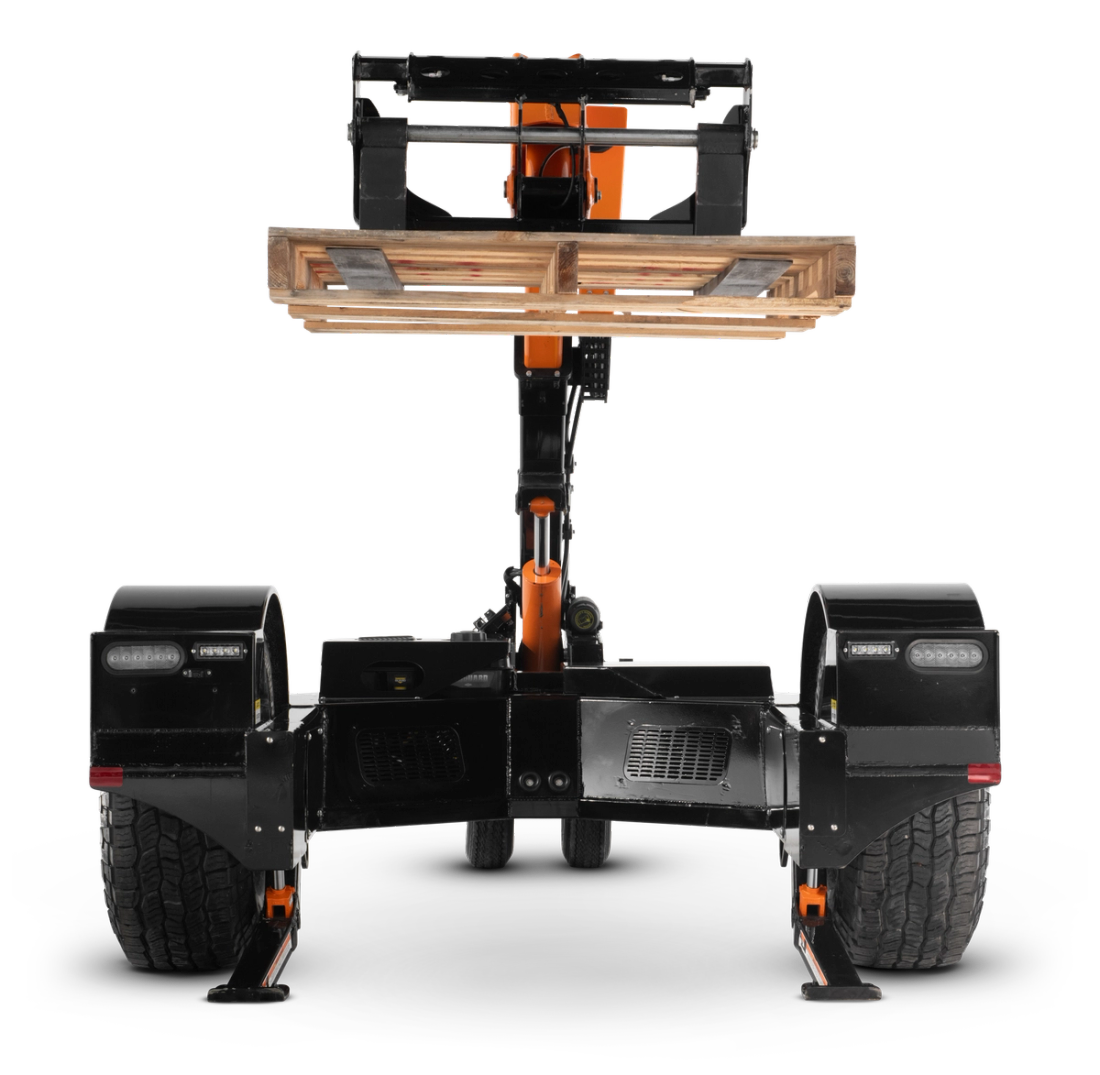
It does not reach and it does not try to. It puts 3,000 lb eight feet in the air, stabilizes on outriggers rather than a fixed counterweight, and weighs about what it lifts — which is why a pickup can bring it and a lawn can take it.
Specifications
- Lift capacity: 3,000 lb
- Lift height: 8'-0"
- Empty weight: 3,160 lb
- Drive: self-propelled, with a skid-steer driving mode for tight turns
- Transport: hitches to a standard pickup like a trailer; switches between Tow Mode and Work Mode in minutes
Controls and safety
- Handheld remote with joystick control and one-click pairing, operator on foot
- Emergency stop
- Outriggers for stability under load
- Work lights for low-light jobs
- Auto engage and disengage between tow and work modes
More on the controls in how the remote control forklift works. Check your vehicle’s tow rating and hitch before hauling any equipment.
Answers
Frequently asked questions
Is a telehandler a forklift?
Yes. A telehandler is a variable-reach rough-terrain forklift — the telescoping boom replaces the vertical mast, but it is the same class of equipment. OSHA treats both as powered industrial trucks, with rough-terrain machines in Class VII, so the same operator training and certification rules apply to each.
Can a telehandler replace a forklift?
For most outdoor lifting, yes — a telehandler does everything a rough-terrain forklift does and adds reach. The question is whether that is worth the cost. You pay more to buy, more to rent, more to transport, and you give up capacity as soon as the boom extends. If the boom stays retracted on most jobs, you bought reach you are not using.
What is a compact telehandler used for?
Unloading lumber and material packages on residential jobsites, placing pallets on framing and scaffolding, and tight urban sites where a full-size machine will not fit. They are also common in agriculture for hay bales and feed pallets, and in landscaping and municipal yards, where a low overall height lets the machine pass through gates and under obstructions.
How much does a compact telehandler cost?
Compact 2.5 to 3.5 ton machines generally run about $48,000 to $68,000 new, with mainstream 6,000 to 10,000 lb construction models roughly $78,000 to $128,000. Used machines list well below that, but condition, hours and service history drive the real number. To rent, expect roughly 10 to 25 percent above a straight-mast rough-terrain forklift, plus delivery.
How do I decide between reach and lift?
Walk your last ten jobs. Count how many needed the load placed somewhere the machine could not drive to. If the answer is most of them, buy the boom. If the answer is one or two, buy for capacity and transport and rent a telehandler on the days you need reach — that is usually the cheaper year.
What is the smallest machine that will move a pallet across a lawn?
A towable outdoor forklift. Indoor stackers and cushion-tire forklifts are not rated for turf, and compact telehandlers and rough-terrain forklifts weigh 10,000 lb and up before they pick anything up. The Equipter Tow-A-Lift carries 3,000 lb at 3,160 lb empty on oversized flotation tires.
Buy for the job you actually run
Spec a Tow-A-Lift for the pallets you move and the truck you already own — or rent one first and put it on your ground.
Keep reading
The whole outdoor category, compared on transport and turf.
Why a small forklift usually is not a light one.
Choosing between the two reach machines.