
For farms and grounds
A Towable Forklift for Farms, Orchards and Grounds Crews
When the tractor is busy, the ground is soft, or the load has to go somewhere a loader cannot reach, a towable forklift moves seed, feed, bins and stone behind any farm truck.
Updated September 18, 2026 · 8-minute read · By the Equipter team, Leola, PA
Equipter Tow-A-Lift specifications.
Most farms already have a way to lift a pallet — a loader, a set of pallet forks, a three-point attachment. The trouble is that it is attached to the tractor, and the tractor is usually doing something else.
A towable outdoor forklift is a second set of forks that does not tie up the tractor. The Equipter® Tow-A-Lift lifts 3,000 lb to 8 feet, weighs 3,160 lb, hitches to any farm truck rated to tow it, and works from a handheld remote with the operator on foot.
The comparison
Tractor forks versus a dedicated outdoor forklift
Pallet forks on a tractor are cheap, and for a lot of farm work they are the right answer. They also come with three constraints that show up the moment the job is precise or repetitive.
Three-point pallet forks
The three-point hitch will lift a great deal, but only a few feet off the ground, and you are reversing to the load with the forks behind you.
Fine for moving a pallet across a yard. Awkward for placing one.
Loader-mounted forks
Better visibility and height, but capacity is set by the loader and drops as the load moves forward of the pins, and you need rear ballast to stay planted.
The heavier the pallet, the more tractor you need underneath it.
A towable outdoor forklift
Rated at 3,000 lb to 8 feet with outriggers for stability, so the number does not move around with ballast or reach.
And it leaves the tractor free to keep doing tractor work.
The honest version: if you own a tractor and lift a pallet twice a month, buy forks. The case for a second machine starts when lifting is on the critical path — a delivery waiting, a crew standing around, or a tractor that has to stop mid-task to go move something.
Between the rows
Orchards, vineyards and nurseries
Orchard work is a distance problem more than a lifting one. Bins, pallets of supplies and harvested fruit have to move between rows that were planted for tractors, not for forklifts, over ground that is soft for much of the season.
A machine at 3,160 lb on oversized flotation tires has a different footprint from a loaded tractor or a rough-terrain forklift, and being able to stand beside the load rather than behind it makes placing bins in a row considerably easier. Nurseries face the same pattern with tree stock, shrub racks and soil pallets: heavy, awkward, and always somewhere the truck cannot reach.
On turf
Cemeteries and grounds crews
Grounds work puts equipment on the most scrutinised turf there is. Mulch, sod, stone and supplies all have to cross maintained lawn, and every mark is visible for the rest of the season.
A mulch pallet runs roughly 1,300–2,800 lb, and sod 1,500–3,000 lb — both inside a 3,000 lb envelope, both awkward to barrow any distance. For setting monuments and headstones, that is a different machine with different reach: see monument setting with a mobile crane, which is the Equipter 5400's job at 4,431 lb and 23 feet of reach.
Public grounds
Golf courses and municipalities
Course and parks crews run into the same three conditions: irrigated turf that marks easily, service routes that were never sized for equipment, and a maintenance fleet where every machine is already committed on a Monday morning.
Pallets of seed, fertiliser, sod, stone and bagged goods all fall inside 3,000 lb, and a machine that tows behind an existing truck can be shared across a grounds department instead of belonging to one shop.
The machine
What it is, in plain numbers
A towable, remote-controlled outdoor forklift. It does not reach like a telehandler and does not replace a loader — it is the second set of forks that shows up without the tractor.
Specifications
- Lift capacity: 3,000 lb
- Lift height: 8'-0"
- Empty weight: 3,160 lb
- Drive: self-propelled, with a skid-steer driving mode for tight turns
- Transport: hitches to a standard pickup like a trailer; switches between Tow Mode and Work Mode in minutes
Controls and safety
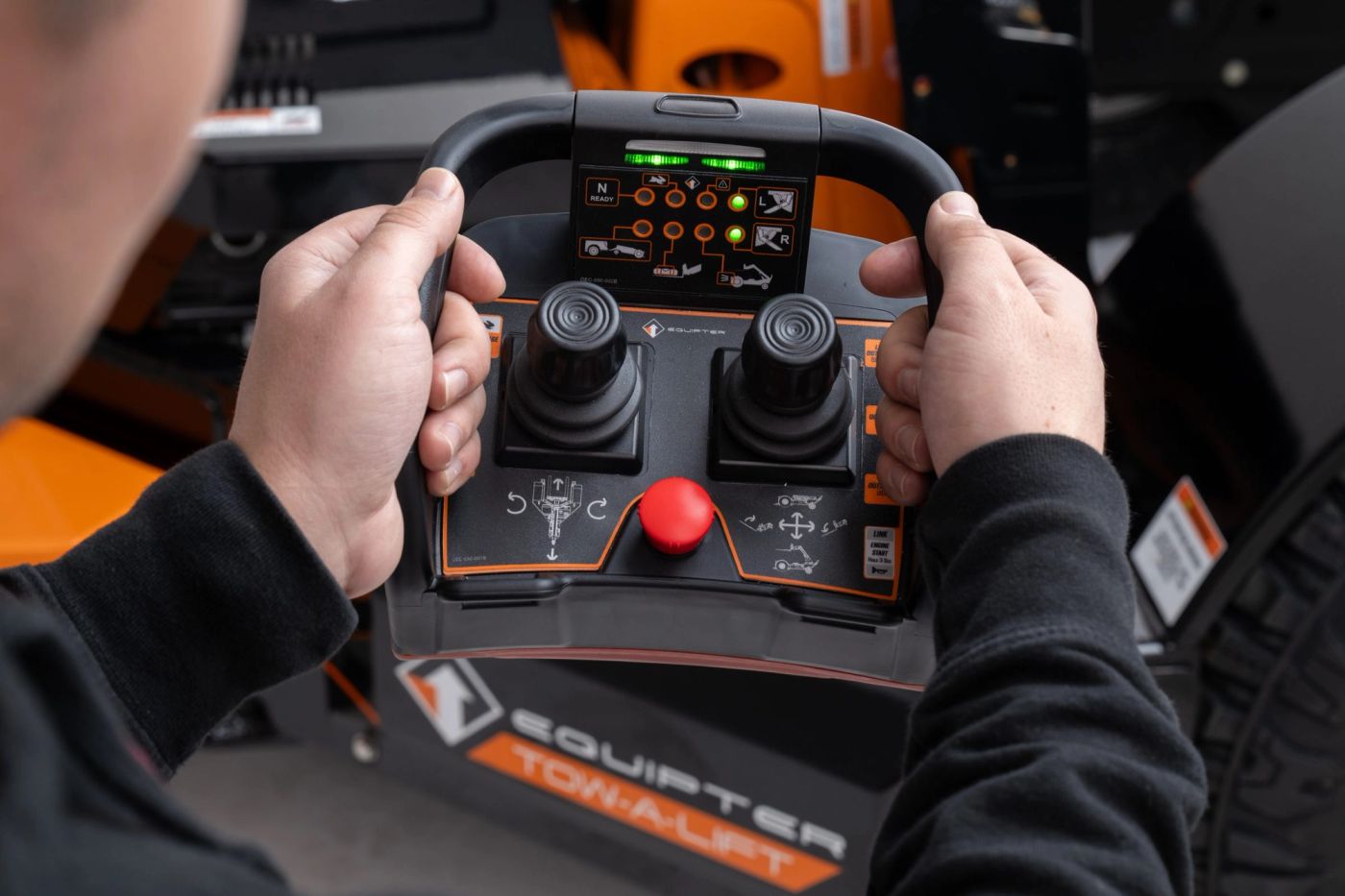
- Handheld remote with joystick control and one-click pairing, operator on foot
- Emergency stop
- Outriggers for stability under load
- Work lights for low-light jobs
- Auto engage and disengage between tow and work modes
More on the controls in how the remote control forklift works. Check your vehicle’s tow rating and hitch before hauling any equipment.
Answers
Frequently asked questions
Can a tractor be used as a forklift?
Yes, with pallet forks on either the loader or the three-point hitch, and for a lot of farm work that is the sensible answer. The limits are practical: rear forks lift only a few feet and you work in reverse; loader forks are capped by loader capacity, which falls as the load moves forward of the pins and requires rear ballast. Both tie up the tractor for as long as the lifting takes.
What forklift works on soft ground?
One with high-flotation tires and low overall weight. The machine's own weight usually matters more than the load: a 3,160 lb towable forklift puts far less into soft ground than a compact telehandler near 10,000 lb or a masted rough-terrain unit around 14,800 lb. No machine is safe to run on saturated ground.
How much can it lift, and how high?
3,000 lb to a maximum height of 8 feet. That covers most palletised farm and grounds material — seed, feed, fertiliser, mulch, sod, stone and supplies — but not the heaviest stone or a loaded monument, which is a mobile crane's job.
Do I need a CDL to tow it?
Not on weight. Federal rules require a Class A CDL only when the combination is rated 26,001 lb or more and the towed unit's GVWR exceeds 10,000 lb; at 3,160 lb empty this is far below that threshold. States can add their own requirements, and agricultural operations often have further exemptions, so check locally and confirm your vehicle's tow rating and hitch.
Can one person operate it?
Yes. It tows behind a truck, drives itself off the hitch, and runs from a handheld remote with the operator walking alongside — useful when the nearest help is on the other side of the property.
What about setting monuments or headstones?
That needs reach rather than a mast. The Equipter 5400 mobile crane lifts up to 4,431 lb with 23 feet of reach and is the machine built for it — see monument setting equipment.
A second set of forks, without a second tractor
Spec a Tow-A-Lift for the loads that keep pulling the tractor off the job — or rent one for the season's busiest weeks.
Keep reading
The whole outdoor category, compared on transport and turf.
Why a small forklift usually is not a light one.
When the load needs reach, not a mast.