
Rentals
All-Terrain Forklift Rental: Why Rental Houses Add a Towable Forklift to the Fleet
Renting a rough-terrain forklift usually means a flatbed delivery. A machine the customer hauls behind their own truck changes the economics — for the renter and for the yard.
Updated September 18, 2026 · 8-minute read · By the Equipter team, Leola, PA
Equipter Tow-A-Lift specifications.
Most all-terrain forklift rentals arrive on a truck. A straight-mast rough-terrain unit typically runs $300–$600 a day or roughly $850–$1,650 a week, and delivery and pickup commonly add $100–$300 each way because the machine cannot get to the job on its own.
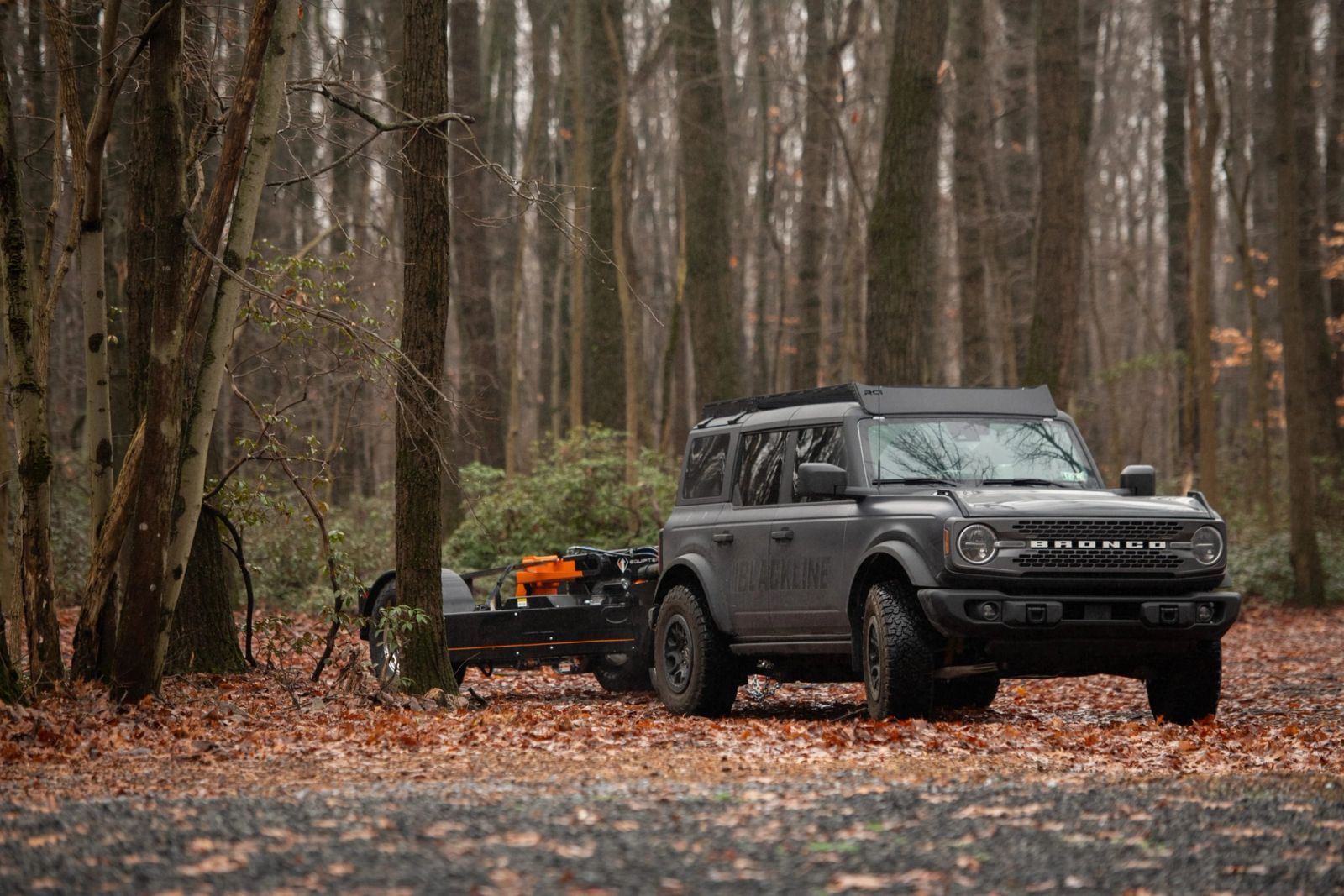
A towable outdoor forklift removes that line item entirely. The renter hitches it to the truck already in their driveway and takes it. For the yard, that means a rental that does not consume a delivery slot. The Equipter® Tow-A-Lift weighs 3,160 lb empty and lifts 3,000 lb.
If you are renting
What an all-terrain forklift rental actually costs
The day rate is the number people compare. It is rarely the number that decides the invoice. Budget these five lines before you book, because on a short rental the extras can rival the machine.
What you pay
- Base rate: roughly $300–$600 a day or $850–$1,650 a week for a straight-mast rough-terrain unit; telehandlers run 10–25% higher
- Delivery and pickup: commonly $100–$300 each way, and past $500 for machines needing a flatbed or lowboy
- Damage waiver: typically 10–15% of the base rate
- Fuel: returned full, or billed at the yard's rate
- Operator training if your crew is not certified: often $150–$300 per person
How to spend less
- Weekly rates commonly discount the daily rate by 30–40%, monthly by 50–60%. Past three or four days, ask for the week.
- Ask whether delivery is included inside a radius — many yards waive it close in, or on monthly contracts.
- Check whether your general liability or inland marine policy already covers rented equipment before buying the waiver.
- Rent the smallest machine that covers your real pallet weight, not your heaviest-ever load.
Run the arithmetic on a one-day rental. A $350 day rate with $250 of delivery and pickup is a $600 day, and roughly 40% of it bought you transport rather than lifting. That ratio is why short all-terrain rentals so often get abandoned in favour of six guys and a wheelbarrow.
The difference
Why “tow it yourself” changes the math
A towable outdoor forklift is the only machine in this category the customer can collect. That single fact moves four things at once.
No delivery line
The $100–$300 each way disappears, which on a one or two day rental is most of the saving available.
No delivery window
You are not waiting on a truck at the start of the day or paying another day because pickup slipped past the cutoff.
Same-day is realistic
If the machine is on the lot and you have a truck, the rental starts when you get there rather than when dispatch has a slot.
It moves between jobs
A week-long rental can follow the crew across three addresses without a redelivery charge each time.
If you run the yard
What a towable forklift does for a rental fleet
The case for carrying one is not that it lifts more. It is that it rents differently from everything else on the yard.
Your truck stays free
Every trailered machine on the lot competes for the same delivery truck and the same driver. A unit the customer hauls goes out without touching either, so it can rent on the days your transport is already committed — which are usually your busiest.
Short rentals become viable
Delivery economics quietly kill one-day rentals: nobody wants to pay $250 of transport on a $350 machine, and the round trip may cost you more than the day earns. Remove transport and a whole category of short rental turns profitable.
One operator, on foot
The machine runs from a handheld remote, so there is no cab to familiarise a renter with. OSHA still requires the renting employer to train and certify their own operators under 29 CFR 1910.178, and that obligation does not transfer to you — but the walkthrough is shorter.
Less exposure on turf jobs
Property damage claims on residential rentals usually come from the machine's own weight, not the load. A 3,160 lb unit on oversized flotation tires is a different risk profile from a 10,000 lb telehandler crossing the same lawn.
There is a longer write-up on the fleet side of this: how an Equipter works into your equipment rental business plan, and financing if you are adding units to the fleet.
Demand
How rental customers find a machine near them
Contractors looking for a towable forklift start on the Equipter site. The rental request asks for a ZIP code and matches the job to nearby Equipter rental locations, so the enquiry arrives already attached to a place and a date.
If you run a yard and want to be one of those locations, get in touch with the team — 717-661-3591 or sales@equipter.com.
The machine
What you are putting on the yard
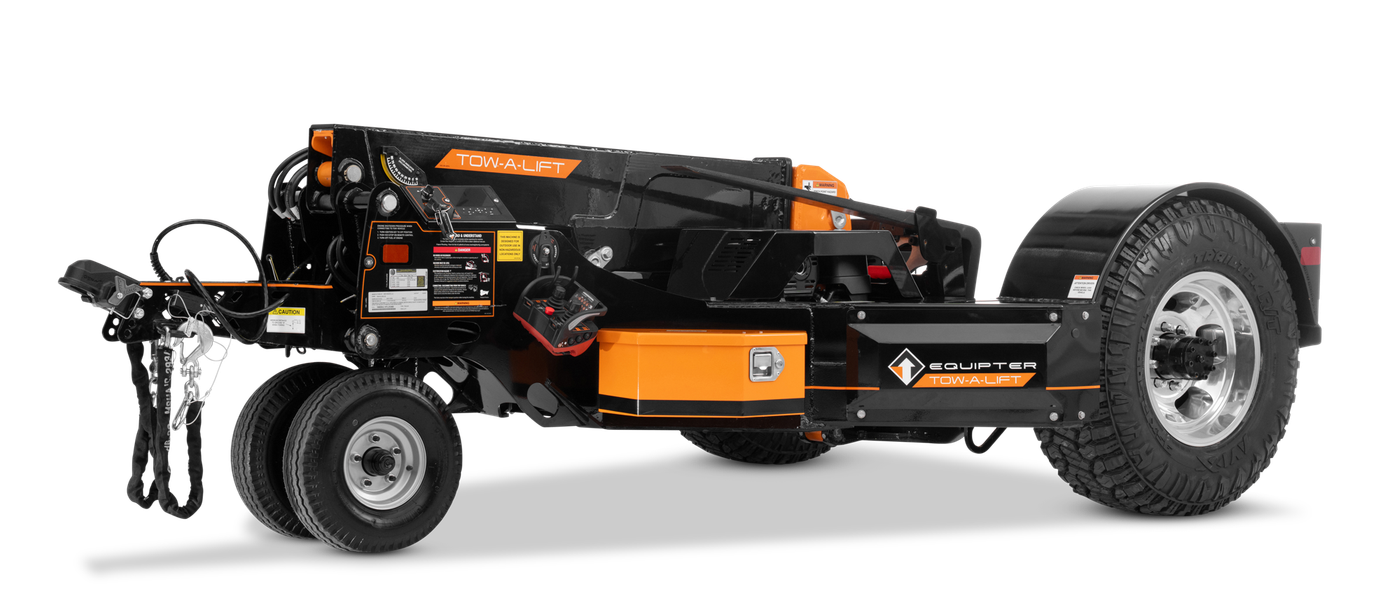
It arrives as a trailer and works as a forklift. Tow Mode and Work Mode swap in minutes, so the same unit that came down the highway behind a pickup drives itself across a lawn under remote control.
Specifications
- Lift capacity: 3,000 lb
- Lift height: 8'-0"
- Empty weight: 3,160 lb
- Drive: self-propelled, with a skid-steer driving mode for tight turns
- Transport: hitches to a standard pickup like a trailer; switches between Tow Mode and Work Mode in minutes
Controls and safety
- Handheld remote with joystick control and one-click pairing, operator on foot
- Emergency stop
- Outriggers for stability under load
- Work lights for low-light jobs
- Auto engage and disengage between tow and work modes
More on the controls in how the remote control forklift works. Renters should check their vehicle’s tow rating and hitch before hauling.
Answers
Frequently asked questions
Can you rent a towable forklift?
Yes. Equipter rental locations across the country carry them, and the rental request matches your ZIP code to nearby yards. Because you collect it yourself, availability is not limited by whether a delivery truck is free that morning.
Do I need a CDL or a trailer to pick one up?
No trailer — the machine tows on its own wheels. On licensing, the federal rule under 49 CFR Part 383 requires a Class A CDL only when the gross combination weight rating is 26,001 lb or more and the towed unit's GVWR exceeds 10,000 lb. Both conditions have to be true. At 3,160 lb empty, a Tow-A-Lift is nowhere near the 10,000 lb trailer threshold, so a CDL is not triggered on weight. States can add their own rules, so check locally, and always confirm your vehicle's tow rating and hitch.
How much does an all-terrain forklift rental cost?
A straight-mast rough-terrain forklift typically runs $300 to $600 a day or roughly $850 to $1,650 a week, with telehandlers 10 to 25 percent higher. Add delivery and pickup at $100 to $300 each way, a damage waiver at 10 to 15 percent of the base rate, and fuel. Weekly rates usually cut the daily rate by 30 to 40 percent, so past three or four days it is worth asking for the week.
Do I need certification to operate a rented forklift?
Yes. Under OSHA 29 CFR 1910.178(l), the employer must train, evaluate and certify each operator for the specific truck type and workplace, and renting the machine does not move that obligation to the rental house. Many yards offer on-site training, commonly $150 to $300 per person, if your crew is not already certified.
Is renting or buying better for a small crew?
Rent while the need is seasonal, tied to one job, or you want to see how the machine handles your ground. Buy once pallets land in the wrong place on most jobs rather than a few, or once delivery fees on repeat rentals start to look like a payment. Financing can spread the purchase.
How do I become an Equipter rental location?
Talk to the team directly — 717-661-3591, sales@equipter.com, or through the contact page. Rental locations are listed in the ZIP-code locator that renters use, so enquiries in your area route to you.
Rent one, or put one on your yard
Find a Tow-A-Lift near the job, or spec one for the fleet and let your customers haul it themselves.
Keep reading
The whole outdoor category, compared on transport and turf.
Reach costs capacity, weight and money.
The fleet case, in more detail.