
Buyer's guide
All-Terrain Forklift Guide: Rough-Terrain, Off-Road and Towable Options Compared
Three different machines share the “all-terrain” label. Here is what each one lifts, what it costs to move between jobs, and how to size one for the pallets your crew actually handles.
Updated September 18, 2026 · 9-minute read · By the Equipter team, Leola, PA
Equipter Tow-A-Lift specifications.
An all-terrain forklift is a forklift built to carry a load across unimproved ground — grass, gravel, mud and half-graded lots — instead of a finished warehouse floor. It runs on large, high-flotation tires with more ground clearance and a frame that stays stable when the ground is not level.
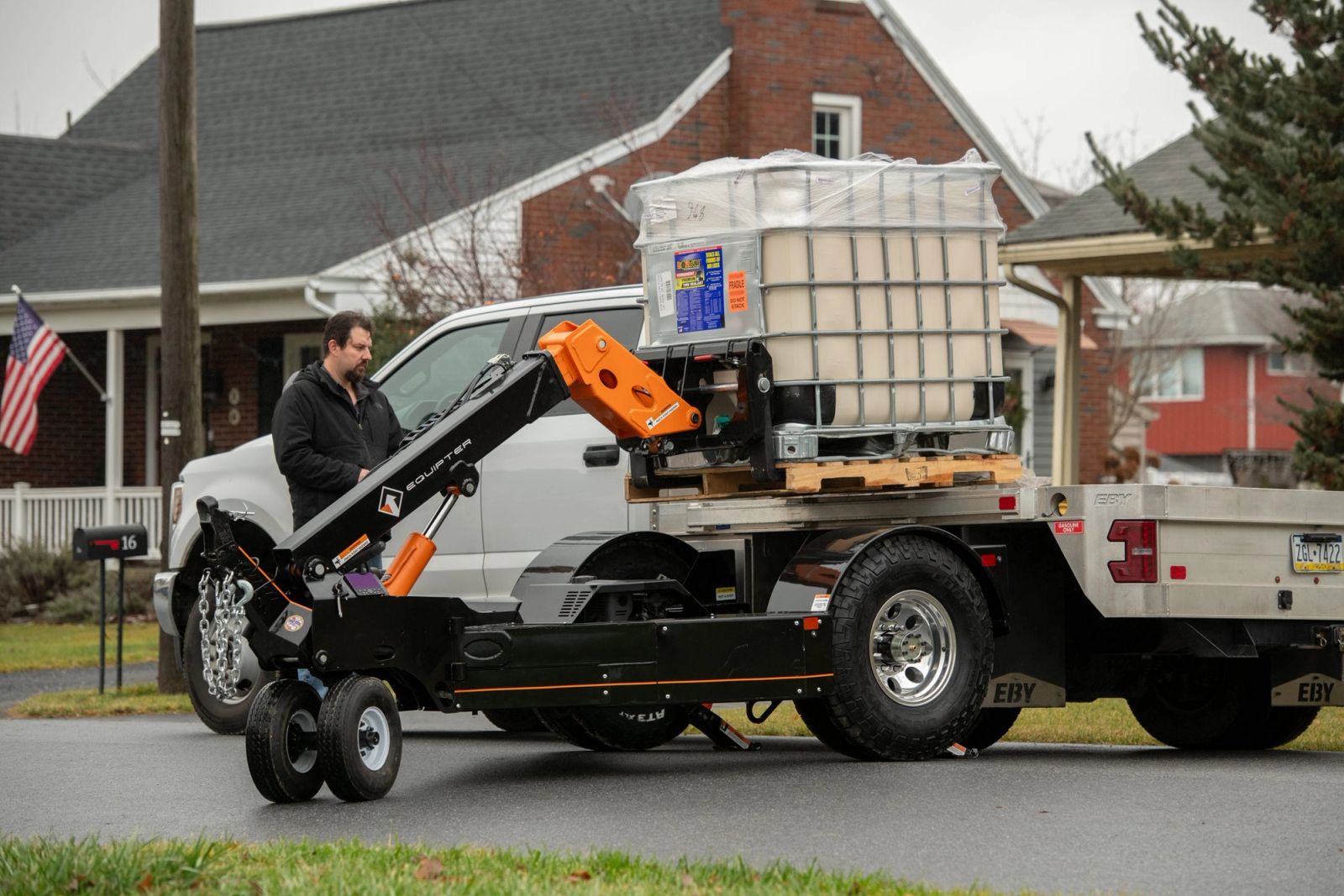
“Rough-terrain forklift” is the older industry term for the same idea; OSHA classifies these machines as Class VII powered industrial trucks. The category covers three machines: masted rough-terrain forklifts, telehandlers, and towable outdoor forklifts such as the Equipter® Tow-A-Lift, which hitches to a standard pickup and lifts 3,000 lb to 8 feet.
The category
What counts as an all-terrain forklift
Three machine types share the label. They handle the same ground; they do not do the same job, and they do not cost the same to move between jobs.
Masted rough-terrain forklifts
A conventional forklift with a vertical mast on a heavy chassis, riding on deep-tread pneumatic tires. It lifts straight up and sets the load close to the machine, so the operator has to drive to the spot. Rental fleets stock these in the 5,000–12,000 lb class, most commonly 6,000–8,000 lb, reaching 11 to 29 feet.
A 6,000 lb unit with a 21-foot mast has an operating weight around 14,800 lb — it rides to the job on a flatbed or equipment trailer.
Telehandlers
A telescoping boom replaces the mast, so the machine reaches forward and up — over a foundation wall, onto a second-floor deck, across a trench. Compact models start around 5,000–5,500 lb at 19 feet; the largest units run past 12,000 lb and 50-plus feet.
Watch the load chart: a 5,000 lb compact telehandler may only carry about 1,850 lb at full reach, and it still weighs around 10,000 lb empty.
Towable outdoor forklifts
Self-propelled forklifts light enough to hitch to a standard pickup. You tow the machine to the site, unhitch it, and drive it onto the job under its own power. Capacity sits at 3,000 lb and lift height in single digits.
At 3,160 lb empty, the Equipter Tow-A-Lift needs no trailer, no flatbed and no second driver.
Side by side
How the three types compare
The rows below are the ones that decide the purchase, not the ones at the top of a spec sheet. Start with the row that costs you the most on a normal week.
Scroll the table sideways to see every column.
| Masted rough-terrain | Telehandler | Towable outdoor forklift | |
|---|---|---|---|
| Lift capacity | 5,000–12,000 lb | 5,000 lb compact, up to 12,000 lb+ | 3,000 lb (Tow-A-Lift) |
| Lift height | 11–29 ft | 19 ft compact, 50 ft+ on large units | 8'-0" (Tow-A-Lift) |
| Reach past the machine | None — mast only | Yes — the main reason to buy one | None — mast only |
| Machine weight | About 14,800 lb (6,000 lb / 21 ft unit) | About 10,000 lb compact; 23,000–27,800 lb on large units | 3,160 lb empty (Tow-A-Lift) |
| How it gets to the job | Flatbed or equipment trailer | Equipment trailer and a truck rated to pull it | Hitches to a standard pickup — no trailer |
| Operator position | Seated on the machine | Seated on the machine | On foot, handheld remote |
| People to move and run it | Driver plus operator | Driver plus operator | One person |
| Typical rental | $300–$600 a day, roughly $850–$1,650 a week, plus delivery | Typically 10–25% above a straight-mast unit, plus delivery | Through the Equipter rental network — you haul it yourself |
| To buy | Dealer quote; new and used market | Dealer quote; highest cost in the category | Quoted through Build + Buy, with financing available |
Category figures are typical published specifications and national rental-fleet rates; they vary by model, market and season, and rental rates exclude delivery, fuel and damage waiver. Equipter figures are for current-production units. Transport is the line most buyers underestimate: a machine that needs a trailer also needs a truck rated to pull it, somewhere to park it, and a second person on the days both have to move.
Sizing
How much capacity do you actually need?
3,000 lb sounds small next to a 10,000 lb machine — until you weigh what a crew moves on an ordinary day. Most standard pallets are packaged to land near 3,000 lb, because that is what suppliers’ own forklifts, pallet jacks and delivery trucks are built around.
What a common pallet weighs
- Architectural shingles, 42 bundles at 60–80 lb — 2,520–3,360 lb
- Standard 8x8x16 concrete block, about 90 units — 2,500–3,500 lb
- Concrete pavers, standard pallet — 2,500–3,500 lb (large-format and natural stone run higher)
- Sod, standard pallet — 1,500–3,000 lb, heavier after rain
- Bagged fertilizer or seed, 40 bags at 50 lb — about 2,000 lb
Size it in four steps
- Weigh the heaviest pallet you move in a normal week, not the one outlier you moved last year.
- Add the weight of any attachment if it is not already in the machine’s rating.
- Check the load chart at the height and distance you actually lift. On a telescoping boom, capacity falls sharply as the boom extends.
- Buy for that number, and rent for the outlier.
Be honest about the top of that range. A wet pallet of sod, a large-format stone pallet or a dense block pallet can push past 3,000 lb, and no 3,000 lb machine should lift it. When that happens the answer is a split pallet from the supplier or two lifts — not buying a 10,000 lb machine you tow on a flatbed for the other fifty weeks of the year.
Right-sizing
Small and compact all-terrain forklifts
“Compact” in this category usually still means a five-ton machine that arrives on its own trailer. On residential work, that is the constraint that matters more than capacity.
Fenced back yards, gates, soft lawns, the gap between a house and a property line, a driveway already holding a dump trailer and two crew trucks — these are the places a big machine stops being useful. The question is not how much it can lift; it is how often it will be on the job at all. A machine that needs a flatbed tends to stay parked on the days nobody wants to hook it up.
The exception is reach. If the load has to travel up rather than out — setting trusses, feeding a second story, placing stone over a wall — reach is the requirement and a boom machine is the right answer. See how the Equipter 5400 mobile crane and 7000 towable boom handler compare for those jobs: the 5400 lifts up to 4,431 lb with 23 feet of reach, and the 7000 reaches 25 feet 5 inches.
The decision
Buying versus renting
- You want to see how a machine handles your ground before committing.
- The need is seasonal, or tied to a single job.
- You are covering an outlier load your own machine is not sized for.
- Find a rental location near the job.
- Pallets land in the wrong place on most jobs, not a few.
- You are already paying for curbside delivery and the labor to move material from there.
- Rental delivery fees are stacking up on top of the day rate.
- One machine can work across several trucks and crews. Financing can spread the cost.
Compliance
Operator training and certification
All of these machines are powered industrial trucks under OSHA 29 CFR 1910.178, which puts rough-terrain forklifts in Class VII. Only trained and authorized operators may run one. There is no OSHA licence to buy: the employer trains each operator, evaluates their performance, and certifies them for the specific truck type and the conditions where it will be used, keeping a record with the operator’s name, the training and evaluation dates, and who did the evaluating.
Each operator has to be re-evaluated at least once every three years, and refresher training is triggered by an accident or near miss, unsafe operation, a change in workplace conditions, or a move to a different type of truck. Construction sites carry the additional requirements of 29 CFR 1926.602. Most rental houses will ask for proof of current certification before they release a machine.
Where we fit
Where the Equipter Tow-A-Lift fits
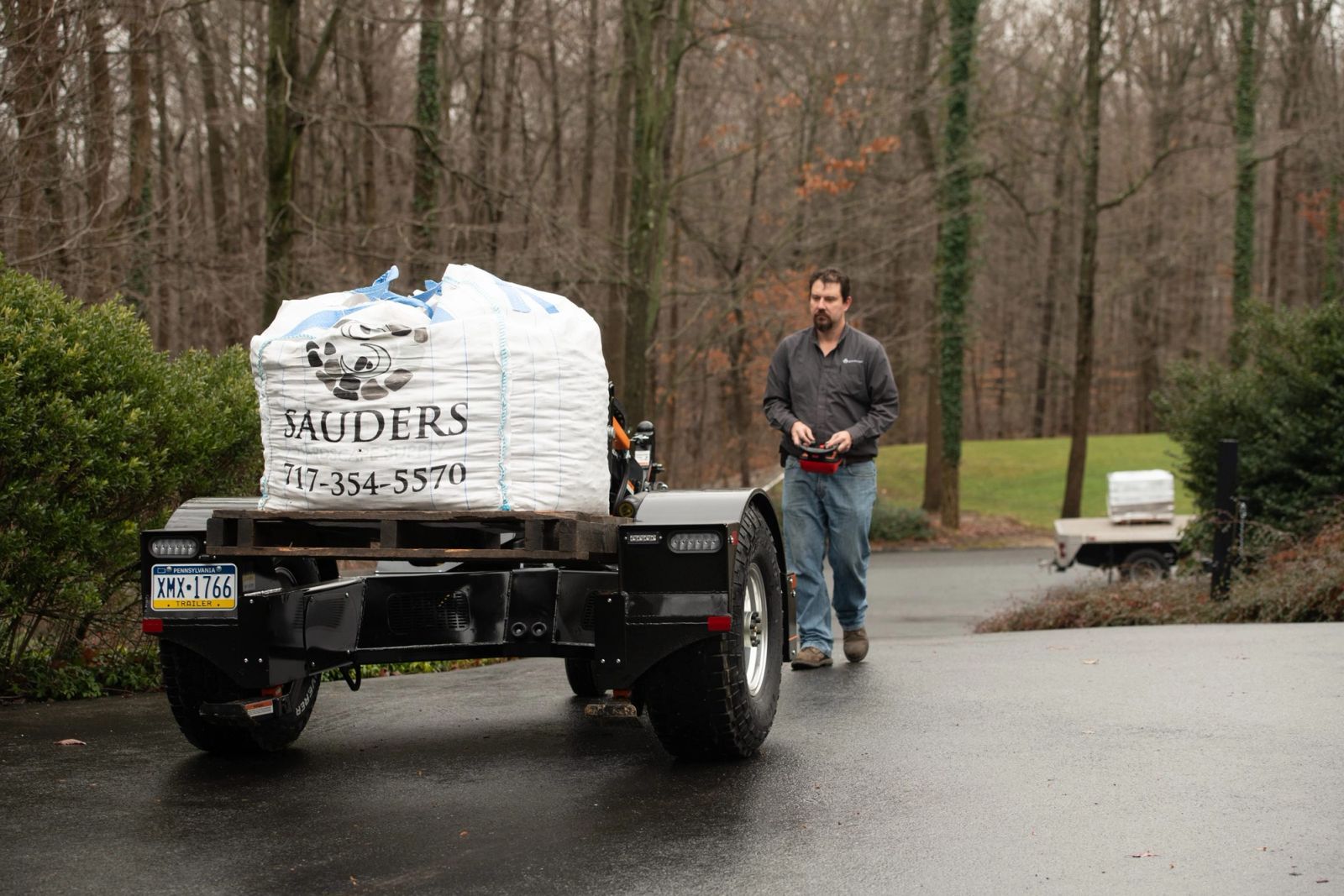
The Tow-A-Lift is the third type: a towable, remote-controlled outdoor forklift sized for the pallet that has to cross a lawn, not for the heaviest load on the continent. It shares the oversized tires and weight-distribution design of the Equipter 4000, so it works across turf and gravel with minimal ground disruption.
Specifications
- Lift capacity: 3,000 lb
- Lift height: 8'-0"
- Empty weight: 3,160 lb
- Drive: self-propelled, with a skid-steer driving mode for tight turns
- Transport: hitches to a standard pickup like a trailer; switches between Tow Mode and Work Mode in minutes
Controls and safety
- Handheld remote with joystick control and one-click pairing, operator on foot
- Emergency stop
- Outriggers for stability under load
- Work lights for low-light jobs
- Auto engage and disengage between tow and work modes
Who runs one: roofing, hardscape and landscape crews moving pallets across finished lawns; supply houses and dealers making site deliveries past the curb; rental fleets that would rather not tie up a delivery truck; and farms, orchards and grounds crews working on soft ground. More on the controls in how the remote control forklift works. Check your vehicle’s tow rating and hitch before hauling any equipment.
Answers
Frequently asked questions
What is a rough terrain forklift?
A rough terrain forklift is a forklift built to work on unimproved ground rather than a warehouse floor. It uses larger, higher-flotation tires, more ground clearance and a heavier frame so it stays stable on gravel, dirt and uneven lots. OSHA classifies these as Class VII powered industrial trucks, and the term is used interchangeably with all-terrain forklift.
What is the best all-terrain forklift for a small business?
The one you can move without a second truck and a second person. For a small crew, transport and operator count usually decide more than capacity: a 3,000 lb machine that hitches to a pickup you already own gets used on far more jobs than a 14,800 lb machine waiting on a trailer.
Can you tow an all-terrain forklift with a pickup?
Towable outdoor forklifts are designed for it. The Equipter Tow-A-Lift weighs 3,160 lb empty and hitches to a standard pickup like a trailer, with no flatbed or specialized vehicle needed — check your truck’s tow rating and hitch first. Masted rough-terrain forklifts and telehandlers are not towable; at 10,000 lb and up they ride on a trailer or flatbed.
Do you need certification to operate one?
Yes. Under OSHA 29 CFR 1910.178(l), only trained and authorized operators may run a powered industrial truck. The employer trains, evaluates and certifies each operator for the specific truck and workplace, and re-evaluates at least every three years. There is no national OSHA licence — the employer’s certification record is the legal document. Construction work adds the requirements of 29 CFR 1926.602.
What forklift works on soft ground and grass?
One with high-flotation tires and low overall weight. The machine’s own weight is usually the bigger factor: a towable outdoor forklift at 3,160 lb empty puts far less on the turf than a compact telehandler near 10,000 lb or a masted rough-terrain unit around 14,800 lb. The Tow-A-Lift was designed around that problem, using oversized tires and weight distribution to cross finished lawns with minimal disruption.
How much does a rough terrain forklift cost to rent?
National rental fleets typically quote $300 to $600 a day and roughly $850 to $1,650 a week for a straight-mast rough-terrain forklift in the 6,000 to 10,000 lb class. Telehandlers usually run 10 to 25 percent higher. Delivery and pickup, fuel and damage waiver are extra, and delivery is the charge that surprises people, because the machine cannot get to the job on its own.
Build the one that fits your crew
Spec a Tow-A-Lift for the pallets you move and the truck you already own — or rent one first and put it on your ground.
Keep reading
Where the operator stands, and why it matters on soft ground.
When reach, not capacity, is the requirement.
Specs, configurations and Build + Buy.